Damning revelations about the UK's chaotic evacuation from Kabul have been described as “unforgivable” and an “astonishing eye opener” by current and former senior MPs.
Key claims by foreign office whistleblower Raphael Marshall included staffing shortages at the Foreign Office — spurred in part by a push to prioritise work-life balance — a lack of linguists and staff members with knowledge of Afghanistan, and emails going unread or ignored.
In damning evidence to MPs on Tuesday, it also emerged that Sir Philip Barton, the Foreign Office's top official, had been on holiday for 17 days in August. He returned only on August 26 — 11 days after the Taliban captured the Afghan capital. Dominic Raab, who was foreign secretary at the time, was also on holiday as the Taliban advanced on Kabul.
Jack Straw, the UK's foreign secretary during the 2001 invasion of Afghanistan, said the revelations were “unforgivable” and an “utter humiliation".
Mr Straw, speaking to a webinar hosted by the Institute for Government, questioned why Mr Raab was on holiday as the Taliban advanced, adding that senior government positions were a “huge privilege” with “huge responsibilities".
With senior foreign office officials on holiday, Mr Straw said they “sent out entirely the wrong messages to the rest of the office. They treated this as a kind of second order issue rather than a first order issue.”
Tobias Ellwood, the chairman of the UK parliament's defence committee, described the revelations by Mr Marshall as “an astonishing eye opener” and criticised the “lack of leadership” at the heart of government.
It came as another Foreign Office whistleblower claimed UK government ministers were more concerned about the “political fallout” from their handling of the Kabul evacuation than protecting lives.
The unidentified civil servant said “harrowing” emails were not being acted on — other than filing a report to say they had been read.
The comments echoed claims by Mr Marshall, who painted a damning picture of the Kabul evacuation in the summer amid the takeover of Afghanistan by the Taliban. He described the handling of the situation as chaotic and dysfunctional.
UK Foreign Secretary Liz Truss, who took on the role in September after the Kabul evacuation, told Chatham House “there clearly are lessons to be learnt".
“The permanent secretary is clear that he should have returned from holiday earlier, as was my predecessor,” she said, referring to Mr Barton and Mr Raab.
Since her appointment, Ms Truss said three measures had been implemented to make sure that there are processes in place at the Foreign, Commonwealth & Development Office to address any future issues, the first being better risk monitoring.
“Secondly, that we have a good emergency response, including a COBR response, should any situation like the one we experienced arise again. And finally, that we are better able to surge employees across the FCDO into any such crisis issue.”
COBR, or COBRA, is the committee convened to co-ordinate the government response to crisis situations.
“I'm absolutely confident that we now have those processes in place in the unfortunate event of a similar situation,” she said.
The anonymous foreign office staff member, described as highly experienced, said the government's main focus was on how it could manage the political consequences.
“The entire operation was to manage the political fallout of what was happening, rather than to actually manage the crisis and that, for me, was the most upsetting and most difficult aspect of it,” the female whistleblower told the BBC.
She said it was difficult to describe the situation was at the time “because it was too upsetting, but also because people wouldn't believe it. It's unforgivable — that's how I'd describe it".
One of Mr Marshall’s claims, which was supported by the unidentified foreign office official, had been that many emails were marked as read so government ministers could say there were no unread messages. He also alleged that on one afternoon, he was the only person monitoring the inbox.
“You had dozens of people reading harrowing, horrific bits of information in emails and knowing full well that nothing was going to be done with any of it, other than a report at the end of the day to say the email had been read,” said the anonymous whistleblower.
She said “that huge amounts of trauma and suffering were either caused directly because of the way it was handled and most probably lives also lost”.
While more than 15,000 people would be evacuated by the UK during those chaotic weeks in August, Mr Marshall said this was only a fraction of those eligible.
-
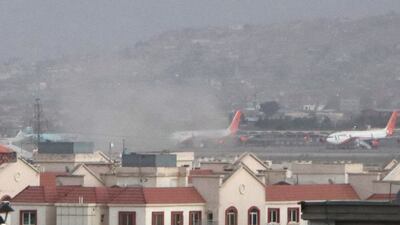
Smoke billows near Hamid Karzai International Airport after a suicide attack in Kabul on August 26, 2021. EPA -

Medical and hospital staff bring an injured man on a stretcher for treatment after a powerful explosion in Kabul. AFP -

The blast occurred outside the Abbey Gate and follows recent security warnings of attacks before the August 31 deadline for US troop withdrawal. EPA -

Volunteers and medical staff bring an injured man for treatment. AFP -

A US official told The Associated Press that the attack outside Kabul airport is 'definitely believed' to have been carried out by ISIS-K. AFP -

A hospital in Kabul said it had received 60 wounded patients. AFP -
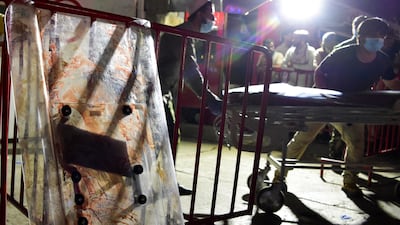
US President Joe Biden has been briefed on the explosion, a White House official stated. AFP


The female foreign office whistleblower said the messaging around where Afghans who worked for the UK should go for evacuation in Kabul was confusing.
“There was no clarity about what advice we can or can't give,” she said.
“Not only was there certainly conflicting information many, many times, but also, I'm sure, in some cases information which people acted on was probably not in their best interest.”
This was despite serious concerns of a terrorist attack by ISIS-K. These fears became reality when the group killed at least 183 people in a suicide bombing outside Kabul airport as thousands of Afghans queued outside the airport in August, attempting to leave the country.